AS physics MCQs help

I need help with this one. I don't understand why the trend is decreasing because V = IR, and R = ρL/A. So if ρ is increasing, then shouldn't R also increase and hence V also increase? I'm confused.
(edited 11 years ago)
Scroll to see replies

Original post by leosco1995
I need help with this one. I don't understand why the trend is decreasing because V = IR, and R = ρL/A. So if ρ is increasing, then shouldn't R also increase and hence V also increase? I'm confused.
As and
So
And as we're considering the distance x, I think we can take it as length of wire, so gradient :-
As the resistivity increases and the cross-sectional area and current remain constant, the gradient also increases. The answer should be B.
Do you get why the gradient is negative?
(edited 11 years ago)
Oh, I see what you did there. But I still don't get why the gradient is negative.. maybe I'm missing something obvious..

Original post by leosco1995
Oh, I see what you did there. But I still don't get why the gradient is negative.. maybe I'm missing something obvious..
Potential drop.
The potential drops as you move along the wire. The drop is biggest for the wire with the biggest resistance. (V=IR and same current in all 3)
The wire with the biggest resistance is the one with the biggest resistivity. (Same length and cross section)
Original post by leosco1995
Oh, I see what you did there. But I still don't get why the gradient is negative.. maybe I'm missing something obvious..
Stonebridge has already answered it qualitatively, but if you want a mathematical proof, here you go:
the voltage at a particular point on the wire is . This will be the voltage at the start of the wire less the voltage lost by resistance
the voltage lost is given by
byt we know that
so we can write
since , and are constant, we now have
so plotting against gives a straight line of gradient
Oh, I see. I never took into consideration that the voltage drops across the wire. Thanks for the explanation guys.

I hate these type of questions.. I don't know where to start and I invariably get them wrong. I just made an equation:
Fnet = ma
x - 6 = 8 * a
Where x is the forward force. But I think I'm wrong and don't know what else to do.
Original post by leosco1995
I hate these type of questions.. I don't know where to start and I invariably get them wrong. I just made an equation:
Fnet = ma
x - 6 = 8 * a
Where x is the forward force. But I think I'm wrong and don't know what else to do.
I hate these type of questions.. I don't know where to start and I invariably get them wrong. I just made an equation:
Fnet = ma
x - 6 = 8 * a
Where x is the forward force. But I think I'm wrong and don't know what else to do.
This might be helpful:
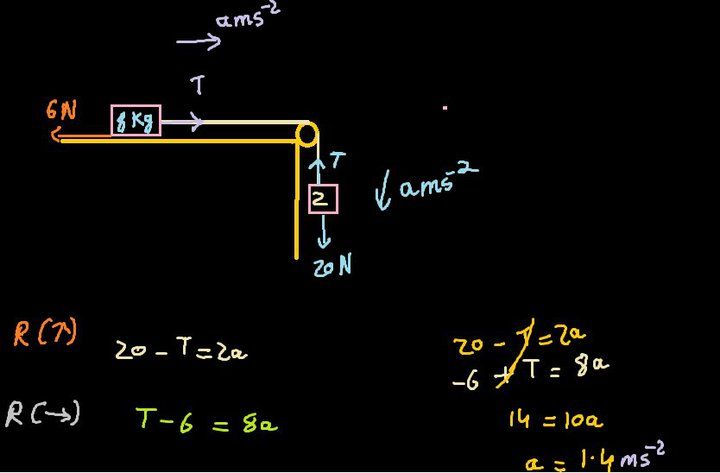
That was really helpful indeed, thanks. 
I don't know how to solve this.. I know that tension is like when you pull something and compression is when you push it.. but I'm still confused because for me it's hard to tell from just looking at a point on the diagram.
I thought A was the answer, BTW.
(edited 11 years ago)
It's common sense really.
If you pull down on that weight, which parts will be stretched (tension) and which will be compressed.
The key is to remember that if you try to bend a bar, the outside edge stretches and the inside edge is compressed.
If you pull down on that weight, which way would you expect the two bars to bend?
If you pull down on that weight, which parts will be stretched (tension) and which will be compressed.
The key is to remember that if you try to bend a bar, the outside edge stretches and the inside edge is compressed.
If you pull down on that weight, which way would you expect the two bars to bend?
Original post by Stonebridge
It's common sense really.
If you pull down on that weight, which parts will be stretched (tension) and which will be compressed.
The key is to remember that if you try to bend a bar, the outside edge stretches and the inside edge is compressed.
If you pull down on that weight, which way would you expect the two bars to bend?
If you pull down on that weight, which parts will be stretched (tension) and which will be compressed.
The key is to remember that if you try to bend a bar, the outside edge stretches and the inside edge is compressed.
If you pull down on that weight, which way would you expect the two bars to bend?
Is that always the case? I mean, when you bend something the outside edge will stretch and inside edge compress? It is kind of hard for me to imagine it on a diagram.
If you don't mind, could you answer this question too? For this one, I've eliminated options B and C (B because it isn't a stationary wave and C because there is some displacement at point R), but I can't tell if it's A or D. How can you figure out the velocity and acceleration from a displacement/distance graph?
Once again, thanks a lot for all of your help.
(edited 11 years ago)
The points on the string are performing SHM.
You should know that for SHM (think of a pendulum) the mass has maximum velocity at the centre and zero velocity at its greatest distance from the centre.
It's acceleration is greatest when furthest from the centre.
Look back at your SHM notes for this.
You should know that for SHM (think of a pendulum) the mass has maximum velocity at the centre and zero velocity at its greatest distance from the centre.
It's acceleration is greatest when furthest from the centre.
Look back at your SHM notes for this.
Original post by leosco1995
Is that always the case? I mean, when you bend something the outside edge will stretch and inside edge compress? It is kind of hard for me to imagine it on a diagram.

If you don't mind, could you answer this question too? For this one, I've eliminated options B and C (B because it isn't a stationary wave and C because there is some displacement at point R), but I can't tell if it's A or D. How can you figure out the velocity and acceleration from a displacement/distance graph?
Once again, thanks a lot for all of your help.
If you don't mind, could you answer this question too? For this one, I've eliminated options B and C (B because it isn't a stationary wave and C because there is some displacement at point R), but I can't tell if it's A or D. How can you figure out the velocity and acceleration from a displacement/distance graph?
Once again, thanks a lot for all of your help.
Do you have CIE Physics MCQs exam in coming days? I just miss doing all these questions. . .

Original post by Stonebridge
The points on the string are performing SHM.
You should know that for SHM (think of a pendulum) the mass has maximum velocity at the centre and zero velocity at its greatest distance from the centre.
It's acceleration is greatest when furthest from the centre.
Look back at your SHM notes for this.
You should know that for SHM (think of a pendulum) the mass has maximum velocity at the centre and zero velocity at its greatest distance from the centre.
It's acceleration is greatest when furthest from the centre.
Look back at your SHM notes for this.
This is interesting.. although I don't think we did SHM in class. I actually thought it was in the A2 syllabus but after going through the AS syllabus I guess it is there. I'll look up some more stuff on it. Thanks for the help.
Original post by Zishi
Do you have CIE Physics MCQs exam in coming days? I just miss doing all these questions. . .
Yeah, it's on 14th June. :P And haha, I can sort of relate to that, I miss doing the MCQs I used to do in my O-levels. I'll probably miss these too.
I hope you guys don't mind me posting all these questions..

I don't understand this one properly. If half of the water gets transferred to the other vessel, wouldn't only the height be halved? The total energy then lost by the water would just be mg * (h/2)? But the answer is mgh/4.
I don't understand this one properly. If half of the water gets transferred to the other vessel, wouldn't only the height be halved? The total energy then lost by the water would just be mg * (h/2)? But the answer is mgh/4.
Original post by leosco1995
Is that always the case? I mean, when you bend something the outside edge will stretch and inside edge compress? It is kind of hard for me to imagine it on a diagram.

Original post by leosco1995
I hope you guys don't mind me posting all these questions..
I don't understand this one properly. If half of the water gets transferred to the other vessel, wouldn't only the height be halved? The total energy then lost by the water would just be mg * (h/2)? But the answer is mgh/4.
I don't understand this one properly. If half of the water gets transferred to the other vessel, wouldn't only the height be halved? The total energy then lost by the water would just be mg * (h/2)? But the answer is mgh/4.
Think where the centre of gravity is for the water in the LHS before opening the tap. The PE of the water in the LHS depends on the height of the c of g. Not the total height of the water.
Think where the c of g is after opening, with half the water now there.
How much PE was lost?
Think where the c of g of the water now is in the RHS
How much PE was gained?
(edited 11 years ago)
Hmm, so if I'm understanding you correctly,
Column X went from mgh to mgh/2.
Column Y went from 0 to mgh/4.
Total loss in P.E = loss in column X + gain in column Y
= -mgh/2 + mgh/4?
I never realized the P.E changes because of the c.o.g and not the height itself.
Column X went from mgh to mgh/2.
Column Y went from 0 to mgh/4.
Total loss in P.E = loss in column X + gain in column Y
= -mgh/2 + mgh/4?
I never realized the P.E changes because of the c.o.g and not the height itself.
Quick Reply
Related discussions
- CIE AS Level MCQ
- Physics A-level
- Lets walk through Year 11 together!
- MME AQA predicted physics a level papers
- Physics 9702 CIE February March 2023 Past Papers
- The topic of Particles in A-Level physics
- Medical Student Finals Fail (urgent advice please)
- AS chemistry paper 2 2022 AQ
- LPC - Best way to prepare for multiple choice questions?
- PAT 2023 / for 2024 entry forum
- OCR A physics paper 3
- Concord College Entrance Test
- Anyone do the Oxford pat 2022
- specimen paper ocr
- Official thread - January 2023 IAL edexcel
- Is it possible to take a combination of A levels Edexcel and CIE A levels?
- Concord College Entrance Exam
- Assessment closed before deadline
- How to prepare and ace theory test??!!!
- Online mcqs postgraduate study